
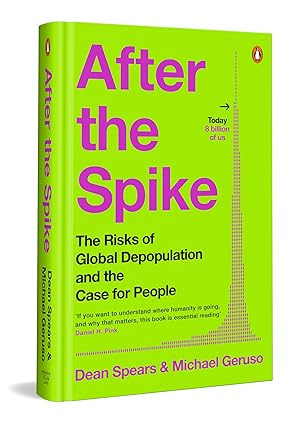

After the Spike by Dean Spears, Michael Deruso (Author)
Original price was: ₹299.00.₹210.00Current price is: ₹210.00.
With new evidence and sharp insights, Spears and Geruso make a lively and compelling case for stabilizing the population―without sacrificing our dreams of a greener future or reverting to past gender inequities. They challenge us to see how depopulation threatens social equity and material progress, and how welcoming it denies the inherent value of every human life. More than an assembly of the most important facts, After the Spike asks what future we should want for our planet, for our children, and for one another.
Out of stock
Description
Most people on Earth today live in a country where birth rates already are too low to stabilize the population: fewer than two children for every two adults. In After the Spike, economists Dean Spears and Michael Geruso sound a wakeup call, explaining why global depopulation is coming, why it matters, and what to do now.
It would be easy to think that fewer people would be better―better for the planet, better for the people who remain. This book invites us all to think again. Despite what we may have been told, depopulation is not the solution we urgently need for environmental challenges like climate change. Nor will it raise living standards by dividing what the world can offer across fewer of us. Spears and Geruso investigate what depopulation would mean for the climate, for living standards, for equity, for progress, for freedom, for humanity’s general welfare. And what it would mean if, instead, people came together to share the work of caregiving and of building societies where parenting fits better with everything else that people aspire to.
About the Author
Dean Spears and Michael Geruso are economists, demographers and associate professors at the University of Texas at Austin. Spears is a founding executive director of r.i.c.e, a nonprofit that works to promote children’s health, growth and survival in rural India. Geruso served as a senior economist at the White House Council of Economic Advisers under President Biden, where he advised on healthcare and population change. Their research on health, population, and climate change has been published in top peer-reviewed journals and featured in publications such as The New York Times, Economist and National Geographic.
Dr. Michael Geruso is an economic demographer, public economist, and associate professor of economics at the University of Texas at Austin. From 2023 to 2024, he served as a senior economist at the White House Council of Economic Advisers, where he advised on issues of health and demography. He holds bachelor’s degrees in engineering, political science, and philosophy. He earned his PhD in economics from Princeton and completed postdoctoral work at Harvard prior to joining the faculty at the University of Texas at Austin in 2014. Since 2014, he has served on the board of the Research Institute of Compassionate Economics (r.i.c.e.). He is an affiliate of the National Bureau of Economic Research and of the Population Research Center at UT-Austin. His work has been published in top peer-reviewed outlets including the American Economic Review,the Journal of Political Economy,and Demography,and has been featured in The New York Times, The Wall Street Journal, NPR, Vox, The Atlantic, and The Economist.
Additional information
| Dimensions | 23 × 15 × 3 cm |
|---|---|
| Binding | Hardcover |
| ISBN | 978-0143475903 |
| Language | English |
| Pages | 336 |
| Publication date | 14 July 2025 |
| Publisher | Penguin Allen Lane |
| Writer | Dean Spears, Michael Deruso (Author) |
Related products
-
370: Undoing the Unjust: A New Future for J&K by BlueKraft Digital Foundation
Original price was: ₹899.00.₹629.00Current price is: ₹629.00. -
How To Think Like Mandela
Original price was: ₹250.00.₹187.00Current price is: ₹187.00. -
The Deras: Culture, Diversity and Politics
Original price was: ₹699.00.₹489.00Current price is: ₹489.00. -
Naaga : Discovering the Extraordinary World of Serpent Worship by K. Hari Kumar
Original price was: ₹499.00.₹374.00Current price is: ₹374.00.


Reviews
There are no reviews yet.